


Precision starts with measurement.
Stationary or rotating? With n-gineric's ng-TTS and ng-vTTR torque sensors, a wide range of measurement tasks can be specifically analyzed.
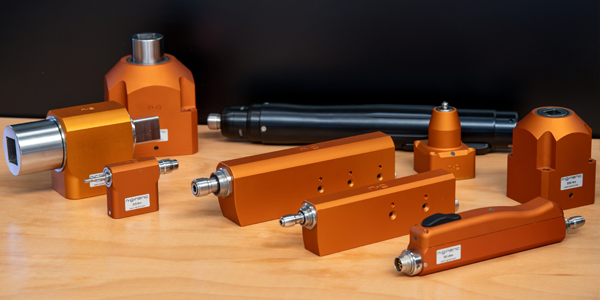
A screwdriver is designed to apply a specific torque. But how can you verify that it actually does so? And how can you determine what happens during the tightening process?
Both questions concern the quality of industrial fastening processes. However, the answers require different measurement methods: While tool testing often focuses on the applied torque, the analysis of a fastening process also involves its temporal and angular behavior.
With its ng-TTS and ng-vTTR sensor series, n-gineric offers measurement technology for both applications.
ng-TTS: Measuring Torque Under Steady-State Conditions
Whether you're inspecting screwdrivers, setting up test rigs, or working in quality assurance: If you want to evaluate torque, you need a reliable measurement.
The ng-TTS series of stationary torque sensors measure the applied torque without rotating along with the screwdriver. They are therefore suitable for measurement applications in which torque is to be measured on a stationary test setup.
The product portfolio covers a range of measurement ranges—from low torques in the centinewton-meter range up to higher torques. Depending on the model, various drive elements and interfaces are available.
The digital models allow measurement values to be transferred via USB; the smart models also offer Ethernet and ng-Link. Integrated torque window monitoring with a signal LED helps ensure that defined measurement ranges are maintained. Mechanical overload protection is also provided for selected smaller measurement ranges.
This allows the ng-TTS series to be adapted to a variety of torque testing requirements.


ng-vTTR: Measuring while the tool is rotating
When analyzing a bolted joint, a single torque value is often not sufficient. It is also interesting to see how the torque changes during rotation and what angle of rotation is covered in the process.
This is where the ng-vTTR comes into play. The rotating torque/angle sensor is integrated into the powertrain and records measurement values during rotation.
One of its distinctive features is its design, which is optimized for high rotational speeds. Thanks to its minimized rotor inertia, the ng-vTTR is suitable for dynamic measurement applications at rotational speeds of up to 10,000 rpm.
The sensor series is available in four measurement ranges: ±80, ±100, ±120, and ±160 Nm. All models feature a ½-inch square drive and a torque measurement accuracy of 0.1% of the full-scale value.
A high-resolution rotary encoder complements the torque measurement. Energy and signal transmission are contactless. USB, Ethernet, and ng-Link are available for data connectivity.
For example, this allows users to record torque-angle curves and analyze different fastening scenarios or tool settings.
Two measurement principles. Different applications.
The key difference lies not only in the design, but also in the measurement task.
The ng-TTS performs stationary measurements. It is the ideal choice when the applied torque needs to be measured and evaluated on a stationary test setup—for example, when testing a screwdriver.
The ng-vTTR takes measurements during rotation. It is used in applications where both the torque and the angular displacement of a bolted joint need to be analyzed. Its design allows for measurements at high rotational speeds.
Both sensor series thus complement each other in the field of industrial torque measurement, rather than performing the same task in different ways.
Visualizing Measurement Data
Recording the measurement values is the first step. To assess them, the data must then be analyzed.
With the n-quirer TT software, n-gineric provides a solution for visualizing and documenting measurement data. Depending on the software version, measurement curves can be displayed, compared, and exported for further analysis.
This makes it possible to see more than just the torque value achieved, especially during rotational measurements: The progression of a bolting operation can be tracked and compared with other measurements.


The measurement task is the deciding factor
Do you want to check the torque of a tool? Or do you want to analyze how torque and angle of rotation change during a fastening process?
This distinction is the first step in selecting a sensor.
With the ng-TTS for stationary torque measurements and the ng-vTTR for rotating measurements, n-gineric offers two specialized sensor series designed to meet different requirements in development, testing, and quality assurance.
After all, precise measurement technology doesn't begin with the measured value, but with the selection of the appropriate measurement method.
Learn more about n-gineric's torque sensors:
https://www.n-gineric.com/
Challenge the status quo.