


Aviation and Aerospace Around the World - An Interview with Jaume
Where precision, process reliability, and productivity come together
The aerospace industry faces major challenges worldwide. Demand is rising, production targets are becoming increasingly ambitious, and quality standards remain uncompromisingly high. At the same time, expectations regarding sustainability, energy efficiency, and digital process control are growing.
In this environment, there is a need for joining technologies that do more than just assemble components. Solutions are needed that ensure safety, simplify processes, and can be flexibly adapted to new requirements.


Where Joining Technology Is in High Demand in the Aerospace Industry
Screw and rivet technology is particularly relevant in four key segments:
- Final assembly lines for aircraft and their suppliers
- Engine and nacelle manufacturers
- Suspension Manufacturer
- Manufacturers of interior components such as seats, electronics, safety systems, and wiring
In all of these areas, precision, repeatability, and seamless process control are essential.
Key Market Trends
Several trends are currently shaping investment decisions in the aerospace industry:
Sustainability and Safety as the Standard
There is a demand for lightweight, ergonomic, and smart tools that are easy to use while also meeting the highest safety standards.
Higher productivity while maintaining the same quality
The industry needs to increase production—without compromising on quality and reliability. That is why robust, versatile, and future-proof solutions are becoming increasingly important.
Energy efficiency is becoming increasingly important
The switch from pneumatic to battery-powered tools offers clear advantages: significantly lower energy consumption, less maintenance, lower noise levels, and greater freedom of movement in the workplace.
Smart Tools for Greater Flexibility
Assembly tools equipped with modern sensor technology enable precise adaptation to different applications, reduce the need for tool changes, and provide a better foundation for process control and traceability.
Technical Challenges in Practice
New technologies also bring new challenges. Many companies are faced with the task of
- to safely integrate smart tools into their processes
- to make the quality assessment more precise
- to reduce the number of tool variants used
- Implementing Connectivity and Traceability Cost-Effectively
It is precisely these issues that require not only good products, but also consulting, training, and a deep understanding of the realities of on-site production.
The Most Common Problems to Solve
In day-to-day operations, the challenges are often very specific: quality issues, process uncertainties, rising production volumes, or a lack of transparency in the assembly process.
What is needed, therefore, are solutions that not only function precisely but also ensure long-term stability—technically, organizationally, and economically.
Four solutions of particular relevance to the aerospace industry
Compact tools for tight spaces
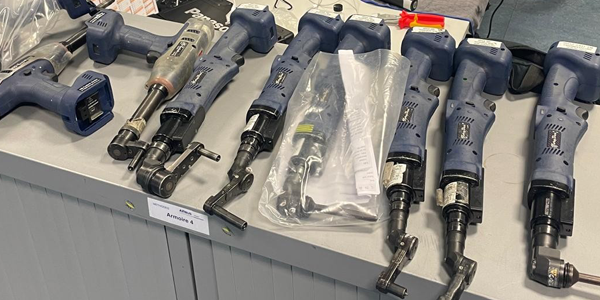
One example is compact screwdriver systems that can be operated with one hand up to 20 Nm and offer clear advantages, especially in hard-to-reach places.
High-precision tools with state-of-the-art sensor technology
EC cordless screwdriver systems with dynamic and dual sensors are particularly in demand for quality-critical applications, as they enable exceptionally precise process control.
Smart Riveting Technology
EC riveting technology with force and stroke monitoring provides additional safety and can be flexibly adapted to different requirements.
Networking and Traceability
The ability to collect, analyze, and trace process data is increasingly becoming the norm in the aerospace market.
Case Studies with Measurable Added Value
Several international projects demonstrate the difference that specialized joining technology can make:
- InFrance, more than 1,000 smart screwdrivers have already been put into use. The result: lower energy costs, fewer tool variants, and significantly improved quality metrics.
- Inthe United Kingdom, a compact cordless screwdriver system provided a solution for more than 2,500 work sites —offering benefits in terms of ergonomics, safety, and productivity.
- InFrance, a particularly sophisticated solution featuring redundant process control was implemented for engine manufacturing.
- In Germany, too, we have a long-standing partnership with a leading engine manufacturer, which is continually being expanded through new projects.
Images from HST and Adobe Stock: By aapsky