

Start-up spirit meets 40 years of precision:
How Ken Is Conquering the American Market with HST USA
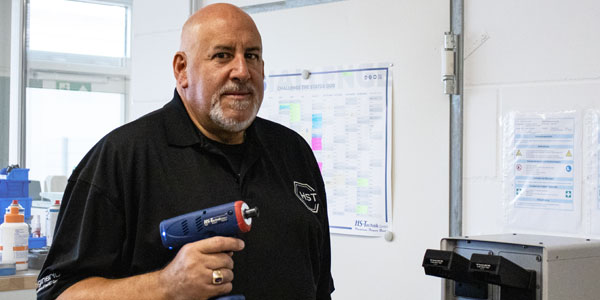
For 40 years, HS-Technik has been a household name worldwide for high-precision joining technology. But the American market operates differently—it is vast, demanding, and, above all, requires a local presence. This is exactly where Ken comes in. Since 2025, he has been the face of HST USA and has been building up our presence in the United States.
From the perspective of a true “startup” backed by a global heavyweight, Ken is taking on the challenges of the U.S. market. In our latest journal article, he shares fascinating insights into his work and the biggest trends in the U.S. industry, and reveals why American aviation giants are suddenly flocking to our tools.
How HST is making a difference in the U.S.
How do you conquer such a huge market? “HST USA is in a real start-up phase, ” Ken laughs. “Even though HS-Technik has been around for 40 years, we first have to build brand awareness here.” The strategy: a smart combination of direct sales and strong dealer partnerships. At the same time, massive investments are being made in logistics. Ken’s credo: “Our products operate with absolute precision. Our logistics and service must reach exactly that level.”
And once users have these tools in their hands, they can solve problems that other brands struggle with. Ken summarizes the four game-changers of HST tools:
- Data from a screwdriver with a mechanical shut-off clutch: Almost no one else on the market offers this.
- Unmatched precision: The repeatability of our EC tools with dynamic sensors often leaves the competition in the dust.
- Prevailing Torque Strategy: Summation of target torque and tightening torque for constant preload forces.
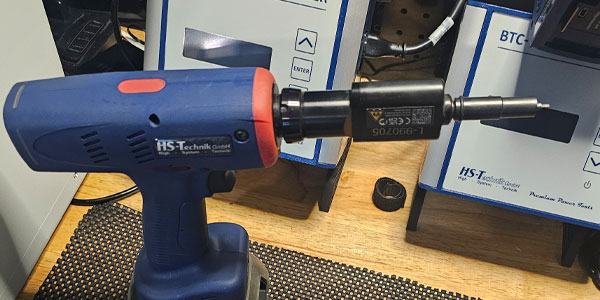
- Special heads and unique sizes: For fastening in the most hard-to-reach places.
The Big Players: Working with the World’s Top 5
Although the company has only recently entered the market, it has already attracted the biggest players. Today, HST USA not only supplies leading players in the aerospace industry but also counts some of the world’s top five engine and propulsion system manufacturers among its customers.
“That was the biggest challenge I took on when I started,” Ken says. Integrating the vBTC tools into this manufacturer’s complex, Solumina-based IT system took time and patience. “But the project managers understand the complexity of the task. And best of all: the company is so convinced that they’re already recommending us to other plants in their network!”
And that's just the beginning: another major player is just starting to collaborate with us, and our sales partner STS is working with great enthusiasm to expand our joint business.
The U.S. Market: Between Mass-Produced Goods and High-Tech
When asked about “General Industry” (GI) in the U.S., Ken initially waves the question away: “That’s an extremely broad term.” Instead of thinking in terms of traditional industries, Ken prefers to divide the market into two distinct worlds: on the one hand, standardized applications where tolerances and data play a secondary role. On the other side, highly complex high-tech applications with state-of-the-art materials, where every hundredth of a millimeter counts and seamless data acquisition is absolutely essential.
Nevertheless, there are four major industries in the U.S. that stand out for their enormous volume of fasteners:
- Automotive Industry
- Aerospace
- Agricultural Technology (Agriculture)
- Heavy-duty trucks (Class 8 trucks)
Behind all these industries lie vast supply chains that converge at the major final assembly plants—a tremendous opportunity for HST USA.
Industry Trends
But what is currently driving these companies? According to Ken, four major trends are currently having a massive impact on investment decisions in the U.S.:
- Rising quality standards: “Good enough” is no longer enough.
- Worker Guidance: Operators need smart tools to guide them through the process.
- Complete documentation: Data is the new gold in assembly.
- Saying goodbye to pneumatic tools: The trend is clearly moving away from bulky air-powered tools toward smart, cordless battery-powered systems.
On top of that, there are technical challenges that would make even experienced engineers break a sweat. “New materials such as modern composites are completely turning our existing knowledge of joint dynamics on its head,”, explains Ken
Another area with enormous potential is a major manufacturer in California. The challenge here is to develop a reliable process so that the team there can mount their own specialized heads onto our tools.
“If we can standardize this, the business potential is limitless,”, Ken says happily.