
Think globally. Act locally.
Roberto on strong distributors, local presence, and international collaboration.
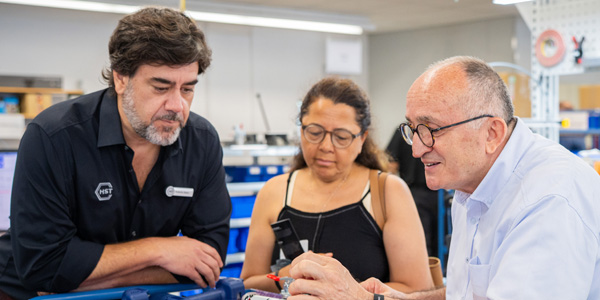
International markets, local presence, and strong partnerships: At HST, Roberto serves as the point of contact for our international distributors worldwide. In this interview, he discusses what makes for a good sales network, how market demands are changing—and why personal relationships remain crucial even in an increasingly digital industry.
Roberto, what does the global HST distributor program mean to you?
For me, it means much more than simply having companies in various countries that resell our products. What really matters is the combination of HST technology and application expertise with our distributors’ local market knowledge.
After all, manufacturing is very local. Customers want to speak with someone who knows their market, can visit their plant, and understands what’s actually happening in the application. Often, it’s only once you’re on site that you realize the real problem is different from what was described earlier over the phone or via email.
The distributor brings this local presence to the table. HST provides the product, training, technical support, and a team of specialists behind the scenes.
So it's not about signing up as many distributors as possible?
No. What matters most are good partners who understand our products, develop their market, and build long-term customer relationships. HST is a specialized manufacturer, and our strength lies in applications where, for example, control, traceability, process documentation, and the flexibility of a cordless tool create real added value. It’s therefore not just about selling a tool. We need to understand where our technology can solve a customer’s problem better or more easily.
What do you think makes a good HST distributor?
He doesn't have to be the biggest. What's much more important is that he knows his customers well, is technically curious, and builds his brand portfolio with a clear logic. A good portfolio isn't simply made up of as many brands as possible. The products and technologies should complement each other in a meaningful way. This is precisely where an opportunity lies for HST: Our solutions can complement existing portfolios and enable the distributor to cover a variety of applications for his customers.
You work internationally with a wide variety of markets. What role do cultural differences play in this context?
A very big one. After 35 years of working internationally, I know the value of cross-cultural experience. You can lose time, trust, and even business opportunities if you don’t understand how your counterpart works, how decisions are made, or how relationships are built in a particular country. You don’t have to know everything. It’s much more important to listen, observe, and be able to adapt. In the international distribution business, this is just as important as product knowledge.

How have the requirements for distributors changed?
Today, a distributor can no longer be just a product supplier. Increasingly, they must also grapple with technological and IT-related issues. The discussion has long since moved beyond mere torque. Communication, data management, interfaces, Wi-Fi, factory networks, and private 5G networks are playing an increasingly important role. Customers want to integrate their tools into production systems and have data available exactly where it’s needed. This makes collaboration between the distributor, the customer, and HST all the more important.
Can a sales partner even handle all this complexity on their own?
No—and he doesn't have to. In this line of work, nothing gets done without teamwork. You have to know what you're capable of and when to call in specialists. Behind our projects are colleagues with deep technical knowledge and countless hours of work behind the scenes. It is precisely this collaboration that makes all the difference.

Where do you see the particular strength of the HST portfolio for distributors?
For me, our strength lies less in any single product than in the combination of our solutions. We offer solutions for fastening technology, riveting technology, measurement technology, and loading systems. When used correctly, a distributor can use these to cover a wide variety of applications for the same customers.
He doesn't have to sell only HST. On the contrary: When different brands and technologies are combined in a meaningful way, the result is a portfolio that offers real added value to the customer.
When do you consider a joint project to be particularly successful?
When a specific application leads to something more. Projects are particularly exciting when, after successful implementation, a solution is expanded to other workstations, production lines, or plants. If this also results in, for example, reduced rework, fewer defective screw connections, improved cycle times, or enhanced traceability, the added value becomes clear.
To me, this is the distribution model at its best: The distributor identifies the problem through its close relationship with the customer; we contribute our technology and expertise; and together we develop a suitable solution.
After many years in international sales: What stands out most in your memory?
