“Quality, not quantity” –
Frank Thies on the Swiss Market
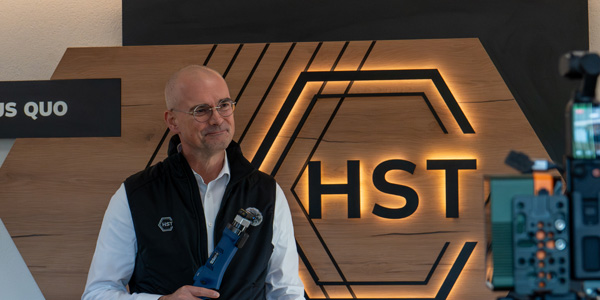
From 5 Nmm in the watch industry to 120 Nm in rail vehicle manufacturing: The Swiss market places exceptionally diverse demands on fastening technology. At the same time, expectations regarding process monitoring, digitalization, and quality are on the rise.
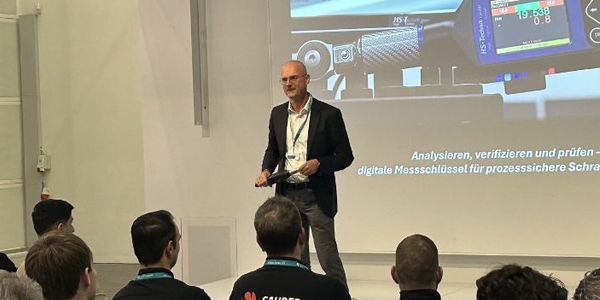
One person who knows this market inside and out is Frank Thies. He started at HST in Business Development and Marketing. He then took on the role of Sales Manager, responsible for the Swiss market. Today, he continues to oversee sales in Switzerland and, as Distributor Manager for D-A-CH, is also responsible for collaborating with sales partners in Germany, Austria, and Switzerland.
Frank has been working in Switzerland for more than twelve years and has known HST for over eight years through their collaboration. In this interview, he discusses industries with particular potential, the growing importance of measurement technology, and why HST is able to showcase its strengths, especially in demanding applications.
Frank, which industries are currently particularly exciting for HST in Switzerland?
Definitely the rail vehicle industry. Despite Switzerland’s modest size, we have a high concentration of rail vehicle manufacturers, rail operators, and maintenance and repair organizations here. Both OEMs and MROs place significantly higher demands on the monitoring of their assembly and joining processes. The driving forces behind this are digitalization as well as changes in regulatory standards.
A particular challenge lies in monitoring and data integration at higher torques of up to 120 Nm, which must be handled safely and ergonomically using a hand-held tool.
At the other end of the torque spectrum are microelectronics, medical technology, and, of course, the watchmaking industry. In these fields, we’re sometimes dealing with torques as low as 5 Nmm, which must be applied and measured with repeatable accuracy and in a way that can be documented. With our sensor-controlled Minimal Torque Systems, we’re very well positioned to handle such specialized processes.
At the same time, we benefit greatly in the Swiss market from the experience we’ve gained in our international focus industries. Our decades-long collaboration with renowned manufacturers in the aerospace industry provides an excellent foundation for sophisticated applications. In turn, our expertise in the automotive and off-road sectors can be applied to integration projects in the rail vehicle segment as well as in commercial and agricultural vehicles.
It is precisely this transfer of knowledge between industries and markets that is a major advantage for us.
What trends are currently influencing investment decisions?
Despite the challenging economic situation, many Swiss companies are investing in the future. It is particularly interesting to note that our high-precision solutions for measuring torque, angular displacement, and force are currently a major focus for our customers.
More and more users are realizing how important it is to truly understand their own processes. Those who can thoroughly analyze a specific fastening application are able to make more informed decisions when selecting fastening technology. At the same time, if discrepancies arise on the production line, they can quickly conduct their own analyses instead of having to rely on a time-consuming external fastening application analysis.
Here, we provide support not only through measurement technology, but also through the expertise we’ve gained from 40 years of experience in fastening technology and our knowledge of current guidelines.

What must modern fastening technology be capable of today?
A few years ago, a tool had to do one thing above all else: tighten screws precisely. Today, the requirements are significantly higher.
Tools must be easy to integrate into existing control systems or worker guidance solutions and, whenever possible, support industry-standard interfaces. As a supplier of fastening technology, this means we must increasingly serve as a competent point of contact for our customers’ IT departments.
At the same time, the screw connections themselves are becoming more complex. Designs involving mixed materials, smaller components and fasteners, and fluctuations in coefficient of friction increase the potential for errors. For small and medium-sized enterprises (SMEs) in particular, this is why greater emphasis is being placed on error detection and prevention before and during assembly. Analysis prior to the start of series production is also increasingly becoming the norm rather than the exception.
How does HST make a difference for Swiss customers?
"Challenge the status quo" describes our approach quite well. We are manufacturers, but we see ourselves first and foremost as solution providers and optimizers for our customers. Our goal is to make the entire process more stable, of higher quality, and ultimately more cost-effective.
Our strength lies particularly in areas where the demands on tools, measuring equipment, and processes are high. This ranges from measurement technology for testing and analysis to sensor-controlled low-torque systems starting at 5 Nmm, and includes our handheld cordless EC tools.
In addition, we offer solutions that are not widely available on the market: for example, our SOP screwdriver with a mechanical shut-off clutch and torque sensor, the EC2 with technically redundant sensors, or the µTDH for applications ranging from 5 to 80 Nmm. Custom solutions and special drive configurations also play an important role—especially when the customer simply cannot access the joint with a standard tool.
To put it simply: Anyone can fasten screws—but not always in the most ergonomic, technically sound, compliant, and cost-effective way. That’s exactly where we want to be your go-to partner.

What role does proximity to Swiss customers play?
A very large one. A distinctive feature of the Swiss market is the cross-border movement of goods. Whenever tools need to be serviced, repaired, or inspected, this can result in additional effort and longer downtime.
We have an advantage here: HST is located just a few minutes from Basel, and we work with two licensed local dealers. Among other things, they can calibrate measuring equipment and perform the necessary machine capability tests on many of our tools.
At the same time, our customers benefit from our global presence. With our own staff and local partners, we identify trends in various markets and can share this experience with them.
There's usually a challenge out there that has already been solved somewhere else.
For me, that is precisely one of the major advantages of our international presence: We combine global project experience with a local focus on our clients.
You've been working with HST for many years. What experience stands out most in your memory?
One major success for me was definitely the relaunch of the HST Group and the integration of n-gineric GmbH. From a marketing perspective in particular, we’ve made tremendous progress in a short amount of time. Marketing is now much more closely integrated into strategic processes, our public image has improved significantly, and we’re continuously reaching new prospects through trade shows and social media.
My most lasting impression of HST, however, dates back even further—to a time when I wasn't even part of the company yet.
At the time, I was facing a challenge with a client who was very important to me—one that I couldn't solve with the portfolio and expertise I had at the time.
I knew about HST in Efringen-Kirchen, but I hadn't had any direct contact with them yet. So I reached out to the managing director—who was in that role then and still is today—and asked if he could accompany me to meet a client and perhaps offer a solution.
He came, advised the customer, and kept his promise to resolve the issue quickly. My customer was satisfied and subsequently became an HST customer himself. Today, nearly all of HST’s technical solutions are in use there—and in the future, internationally as well.
To me, this story really highlights the essence of the HST Group: We’re a team, owner-managed, with quick decision-making processes and tech-savvy decision-makers who are also out in the field with our customers.
After more than twelve years of working and living in Switzerland, I see great long-term potential for HST—precisely because we want to stand for quality rather than quantity.
Switzerland is characterized by a large number of specialized companies and SMEs. At the same time, we find applications here across a wide range of industries: from aerospace and automotive to rail vehicles and agricultural technology, all the way to medical technology and the watch industry. Wherever quality, profitability, and safety place high demands on the process, I see opportunities for us.